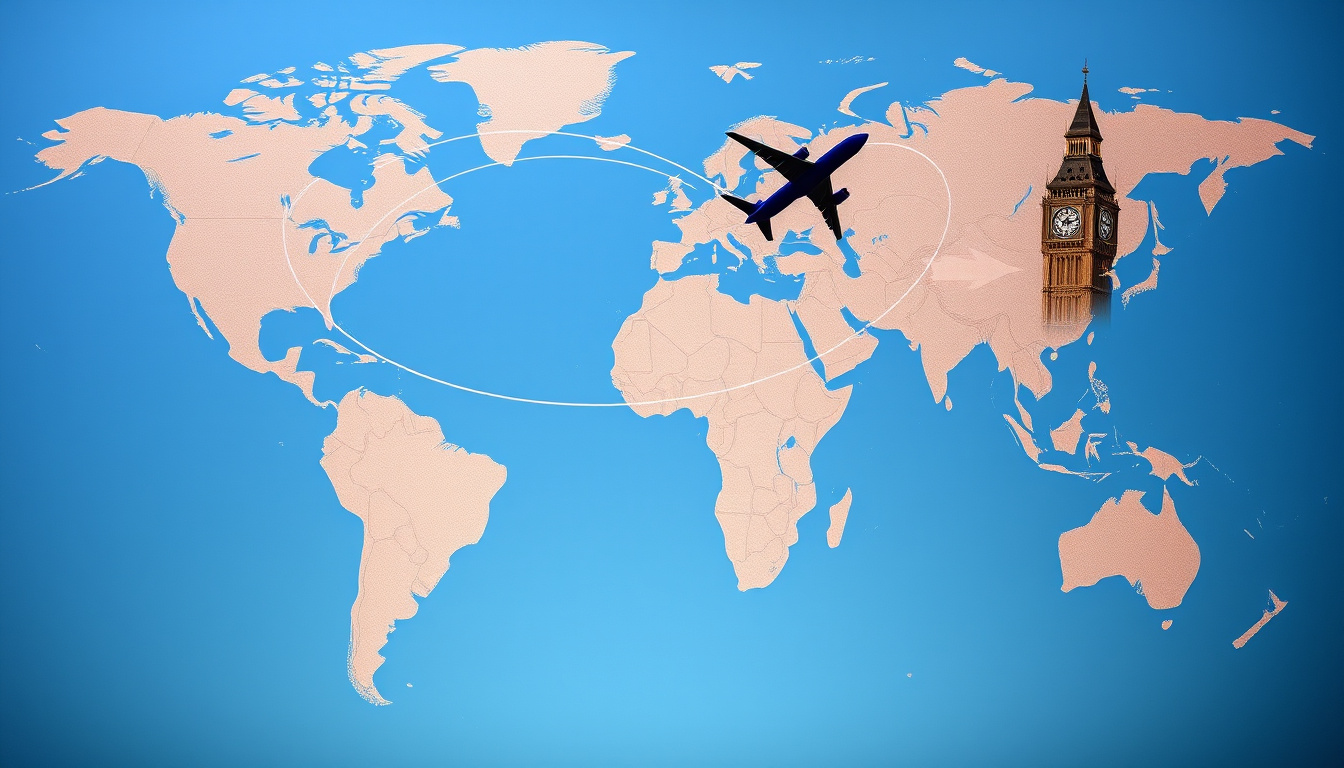
Travelling from Sydney to London ranks among the longest regular passenger routes in the world. The journey connects two global cities separated by roughly 17,000 kilometres of ocean, mountain ranges, and everything in between. Whether planning a once-in-a-lifetime trip or regular business travel, understanding the practical realities of this route helps travellers prepare for what lies ahead.
The flight path crosses multiple time zones and typically involves at least one stopover. Several airlines serve this corridor, with routes historically threading through Middle Eastern and Asian hubs. Prices fluctuate significantly depending on the season, and the experience of jet lag can be considerable given the westward journey across more than ten time zones.
How long is the flight from Sydney to London?
The total travel time from Sydney to London depends heavily on whether the journey includes a stopover and how long that layover lasts. Non-stop flights do not currently operate on this route, meaning every traveller will spend time on the ground somewhere between Australia and the United Kingdom.
Key insights for planning
- The shortest route passes over China’s Sichuan province at a bearing of 302.47° WNW, with the midpoint coordinates at 28.66°N, 104.78°E.
- Typical one-stop journeys via Dubai, Doha, or Singapore take between 24 and 28 hours total when layover time is included.
- Emirates flights through Dubai on the Airbus A380 have recorded journey times as short as 23 hours 30 minutes with an efficient connection.
- Qantas has announced plans to launch direct Sydney-London services by 2027 using the Airbus A350-1000ULR, which could cut airborne time to approximately 20 hours.
- Perth-London direct flights operated by Qantas using Boeing 787-9 aircraft take 17 hours 20 minutes, offering a shorter option for those willing to travel via Western Australia.
- Wind patterns, aircraft type, and load factors cause actual flight times to vary by one to three hours in either direction.
| Fact | Details |
|---|---|
| Great-circle distance | 17,011 km (10,570 miles) via Vincenty’s formula |
| Haversine approximation | 17,020 km (10,576 miles) |
| Average commercial speed | 500 mph (805 km/h) |
| Common layover hubs | Dubai (DXB), Doha (DOH), Singapore (SIN), Bahrain (BAH) |
| Typical layover duration | 7–9 hours for single stopovers |
| Carbon footprint | Approximately 1,392 kg CO₂ per passenger |
What is the distance from Sydney to London?
The straight-line distance between Sydney Kingsford Smith Airport and London Heathrow spans approximately 17,011 kilometres, or about 10,570 miles. This measurement uses Vincenty’s formula, which accounts for the Earth’s ellipsoidal shape rather than treating the planet as a perfect sphere.
The flight path does not run directly south-north or east-west. Instead, aircraft follow a great-circle route that curves northward over Asia. The bearing from Sydney to London measures 302.47° west-northwest, taking aircraft over central China before descending toward Europe. This route appears curved on flat maps but represents the shortest path around the Earth’s sphere.
The antipodal relationship between these cities means they sit almost exactly opposite one another on the globe. Sydney sits at approximately 33.9°S, 151.2°E, while London rests at 51.5°N, 0.1°W. The longitudinal difference of roughly 151° places the two cities on nearly opposite sides of the international date line as well.
What is the time difference between Sydney and London?
London sits eleven hours behind Sydney during standard time periods. When Australia operates on Eastern Standard Time (AEST, UTC+10) and London operates on Greenwich Mean Time (GMT, UTC+0), the difference reaches its maximum.
This gap narrows to ten hours during the United Kingdom’s summer months. Britain adopts British Summer Time (BST, UTC+1) from late March through late October. Australia, however, shifts to Eastern Daylight Time (AEDT, UTC+11) earlier in autumn and returns to standard time later, creating the asymmetric offset during the northern summer.
Managing jet lag on this route
Crossing eleven time zones westward creates a physiological challenge known as eastward jet lag. Travellers typically find it harder to advance their sleep schedule than to delay it, meaning adjustment to London time requires deliberate effort.
Most travellers require five to seven days to fully adjust their sleep patterns. Strategies that help include adjusting bedtimes before departure by one to two hours, staying well-hydrated throughout the flight, using melatonin supplements if appropriate, and exposing yourself to morning light upon arrival in London.
The direction of travel matters significantly. Westbound flights from Sydney to London cross fewer time zones in terms of actual body clock disruption than eastbound journeys would, but the accumulated fatigue from a twenty-plus hour flight still affects recovery time.
Are there direct flights from Sydney to London?
No airline currently operates a non-stop service between Sydney and London Heathrow. All routes require at least one intermediate stop, typically in the Middle East or Southeast Asia. This gap in direct service has persisted despite strong demand on what aviation enthusiasts call the Kangaroo Route.
Qantas and British Airways historically operated versions of the Kangaroo Route through various hubs. The route originally passed through Singapore, later through Bahrain, and more recently through Dubai. Each carrier served segments, forcing passengers to change planes at connection points.
Which airlines serve this route?
- Qantas leads direct route planning, announcing targets for non-stop Sydney-London service by 2027 using Airbus A350-1000ULR aircraft.
- British Airways offers connections through its hub network, typically routing through London or Middle Eastern partner airports.
- Emirates provides one-stop options via Dubai, with layovers of seven to nine hours on most connections.
- Qatar Airways routes through Doha, offering reliable one-stop service on Qatar’s modern fleet.
- Singapore Airlines uses Singapore Changi as a transit point, known for efficient connections and quality service.
- Etihad Airways offers another Middle Eastern option via Abu Dhabi.
Which airports handle these flights?
| Airport | Code | Role on this route |
|---|---|---|
| Sydney Kingsford Smith | SYD | Primary Australian departure point for international long-haul flights |
| London Heathrow | LHR | Main London airport for long-haul arrivals; best connections to SYD |
| London Gatwick | LGW | Common for Qantas and BA services; south of central London |
| London City | LCY | Shorter flight times possible (~20h 29m) but fewer route options |
Many carriers offer free or low-cost stopovers when booking multi-city itineraries. Spending one to three days in Dubai, for example, breaks up the journey while allowing time for sightseeing. Emirates in particular has promoted stopover programs that include hotel discounts and city tours.
How much do flights from Sydney to London cost?
Economy fares on this route typically range from AUD 1,000 to AUD 1,500 for a one-way ticket during off-peak periods. Round-trip prices generally fall between AUD 1,200 and AUD 1,800 during low-demand seasons. Peak travel periods can push return fares to AUD 2,500 or higher.
Several factors drive these price fluctuations. Seasonal demand peaks twice yearly: during the Australian summer from December through February, when school holidays coincide with peak travel, and during July when British schools break and European travel reaches its annual high.
Finding cheaper fares
- Book three to six months ahead for the best chance at lower fares, especially for peak season travel.
- Target February through May or the period from October through November for the lowest prices.
- Use flexible date search tools on aggregators like Google Flights or Kayak to identify cheaper travel days.
- Consider Tuesday or Wednesday departures, which often carry lower demand and therefore lower prices.
- Check alternate airports including Gatwick, which sometimes offers fares unavailable at Heathrow.
- Watch for promotional codes and seasonal sales from major carriers serving this route.
Fare data reflects historical patterns and current projections. Prices fluctuate by thirty to fifty percent seasonally and can shift rapidly based on fuel costs, currency exchange rates, and demand surges. Always verify current pricing at time of booking through official airline or aggregator channels.
The Sydney to London flight journey
Understanding the sequence of events during this long-haul journey helps travellers prepare practically. The experience breaks into distinct phases, each with its own considerations.
- Check-in and departure from Sydney — Passengers typically begin their journey at Kingsford Smith Airport, Australia’s busiest international hub. Online check-in opens twenty-four hours before departure for most carriers.
- First flight segment — The initial leg toward the layover hub typically lasts ten to twelve hours, depending on the destination. Crossing the Indian Ocean or Southeast Asia forms this portion of the journey.
- Layover at connection point — Stopovers commonly run seven to nine hours for efficient connections, though travellers can request longer stops when booking to explore additional destinations.
- Second flight segment — The final leg toward London generally takes seven to ten hours, crossing Europe from east to west before descending into British airspace.
- Arrival in London — Customs and immigration processing at Heathrow, Gatwick, or other London airports completes the journey. eGate eligibility is available for Australian citizens, speeding up border processing.
What we know and what remains uncertain
Certain facts about this route are firmly established through geographic mathematics and aviation records. Other aspects involve variables that shift based on circumstances beyond anyone’s control.
| Established facts | Variable factors |
|---|---|
| Great-circle distance: 17,011 km | Actual flight times fluctuate by 1–3 hours based on wind patterns |
| Time difference: 10–11 hours (London behind Sydney) | Seasonal pricing varies 30–50% between peak and off-peak periods |
| No current non-stop SYD-LHR service exists | Qantas direct route launch date depends on aircraft availability and certification |
| All current routes require at least one stopover | Weather disruptions can delay or reroute flights unexpectedly |
The Kangaroo Route: historical context
The Sydney to London corridor holds a special place in aviation history. Known as the Kangaroo Route due to the emblem of Qantas, this path between Australia and Britain ranks among the world’s most historically significant long-haul corridors.
The route’s evolution reflects changes in aircraft technology and international aviation agreements. Early services required multiple stops with refuelling stops across Africa and the Middle East. The introduction of the Boeing 747 in the 1970s allowed fewer stops, while the 1990s and 2000s saw new-generation aircraft progressively extend range capabilities.
Today’s one-stop services via Dubai, Doha, or Singapore represent the current state of technology, but that stands to change. Qantas has committed to launching direct services using Airbus A350-1000ULR aircraft, which would eliminate the need for any intermediate stop. The airline has announced a 2027 target for this milestone, though regulatory approvals and aircraft delivery schedules will determine the exact timeline.
Sources and official information
Travellers benefit from consulting authoritative sources when planning this journey. Official airline websites provide the most current routing and pricing information, while government resources clarify entry requirements.
Qantas has announced plans for direct Sydney-London flights by 2027 using Airbus A350-1000ULR aircraft, representing a potential revolution in this historic corridor.
The International Air Transport Association maintains comprehensive global standards and publishes travel information relevant to this route. Aviation data aggregators like Flightradar24 track real-time flight information that supplements official scheduling data.
Summary
The flight from Sydney to London covers approximately 17,011 kilometres and requires twenty-plus hours of airborne time, plus layover duration. No direct flights currently operate on this route, with all services requiring at least one stop in the Middle East or Southeast Asia. The time difference ranges from ten to eleven hours depending on the season, and jet lag typically requires five to seven days to overcome.
Prices vary significantly by season, with February through May and October through November offering the most affordable fares. Major carriers including Qantas, British Airways, Emirates, and Qatar Airways serve the route through their respective hubs. Australian citizens need a visa-free stay of up to six months but will require an Electronic Travel Authorisation from 2025.
For those planning broader Australian travel, the Tokyo to Osaka – Best Ways Times Costs Shinkansen 2025 guide offers practical information on domestic Asian connections. Similarly, the Bridestowe Lavender Farm – Tasmania Visit Guide and Tips provides regional Australian travel inspiration for those extending their journey beyond London.
Frequently asked questions
Do I need a visa to fly from Sydney to London?
Australian citizens can visit the UK visa-free for up to six months. An Electronic Travel Authorisation (ETA) will be required from 2025, costing approximately £10 and applied for online before departure.
What is the shortest flight from Sydney to London?
Currently, no non-stop service exists. The shortest journey with a layover takes approximately 23 hours 30 minutes via Dubai on Emirates. Qantas plans direct service by 2027 using A350-1000ULR aircraft, estimated at 20 hours.
Which airline is best for Sydney to London?
Qantas, British Airways, and Emirates rank among the top choices for reliability and service quality on this route. Qantas offers particular value for frequent flyers through its loyalty program synergies with partner airlines.
How do I minimise jet lag on this route?
Adjust sleep schedules before departure, stay hydrated during the flight, consider melatonin supplements if appropriate, and expose yourself to morning light upon arrival in London to help reset your body clock.
When should I book for the cheapest fares?
Book three to six months ahead and target February through May or October through November for the lowest prices. Avoid December through February and July when demand peaks and prices rise substantially.
Can I stop over on the way to London?
Yes. Many airlines offer free or low-cost stopovers when booking multi-city itineraries. Dubai, Doha, Singapore, and Bahrain all serve as practical stopover points with attractions worth exploring for one to three days.
What is the carbon footprint of this flight?
A Sydney to London flight produces approximately 1,392 kg of CO₂ per passenger. This figure represents roughly 70% of an average person’s annual carbon budget, making it one of the higher-impact individual travel choices available.

Thomas Webb leads fact-checking, source verification and corrections at Aussie Insightly.