
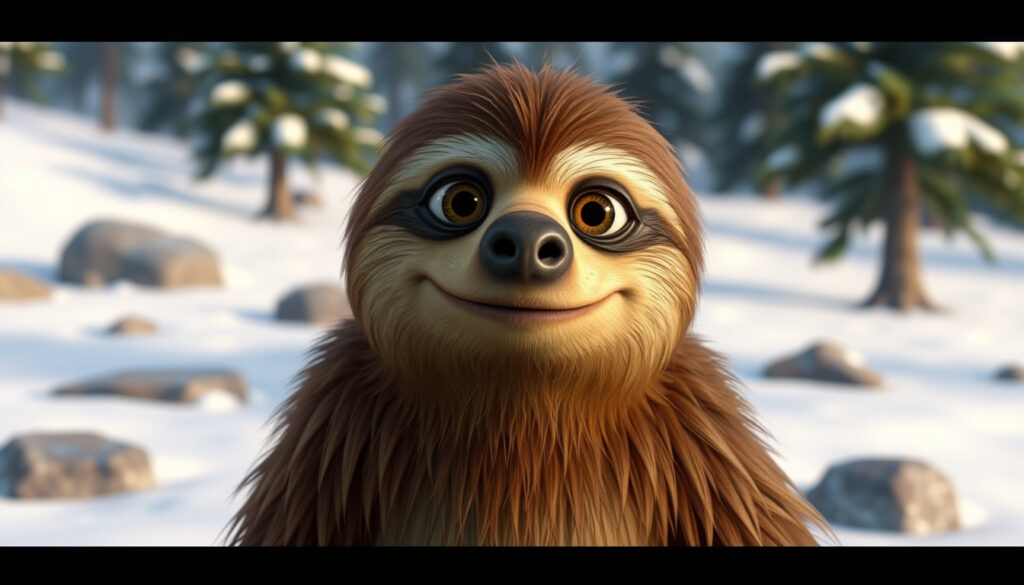
There’s a reason Sid the Sloth remains one of the most recognisable animated characters two decades after his debut. He’s a lovable, clumsy ground sloth who stumbles through the Ice Age films with more heart than brains — but the animal he’s based on, the Shasta ground sloth (Nothrotheriops shastensis), was a real creature that roamed North America during the Pleistocene. This guide separates the cartoon from the fossil so you know exactly what kind of sloth Sid is, how he compares to the real thing, and why that long-clawed pose isn’t just for laughs.
Species: Shasta ground sloth (Nothrotheriops shastensis) ·
First appearance: Ice Age (2002) ·
Voice actor: John Leguizamo ·
Film appearances: 5 mainline films (2002–2016) ·
Real-world sloth size: Approx. 2.75 m (9 ft) tall, 250–500 kg
Quick snapshot
- Sid is a Shasta ground sloth, as identified by paleontologists at the Natural History Museum of Los Angeles (U.S. National Park Service paleontology resource).
- Voice actor John Leguizamo performed Sid in all five main films (Wikipedia franchise entry).
- Shasta ground sloths stood about 9 ft tall and weighed up to 550 lb (250–500 kg) (U.S. National Park Service species fact sheet).
- The exact age of Sid within the fictional timeline is never stated. (San Diego Natural History Museum fossil description)
- Whether Shasta ground sloths had fur as long and shaggy as Sid’s is unknown — no soft tissue survives (San Diego Natural History Museum fossil description).
- Giant ground sloths evolved in South America ~35 million years ago (San Diego Natural History Museum evolutionary timeline).
- Shasta ground sloths lived during the late Pleistocene, alongside early humans (U.S. National Park Service Pleistocene range).
- Paleogenomic studies may clarify whether Shasta ground sloths had long, thick fur like Sid.
- No new Ice Age film is confirmed, but the franchise continues in spin-off media.
Six facts, one pattern: Sid’s on-screen clumsiness mirrors the real Shasta ground sloth’s anatomy — but with a generous dose of Hollywood exaggeration.
| Label | Value |
|---|---|
| Full name | Sidney (callsign: Sid) |
| Species | Shasta ground sloth (Nothrotheriops shastensis) |
| First film | Ice Age (2002) |
| Voice actor | John Leguizamo |
| Real sloth size | 9 ft tall, 500 kg |
| Lifespan (character) | Pleistocene epoch (fictional) |
The pattern: Sid is a cartoon, but his species is real — and the fossil record tells a stranger story.
What animal is Sid the Sloth?
Sid as a fictional ground sloth in the Ice Age franchise
- Sid is a fictional ground sloth, specifically a Shasta ground sloth (Nothrotheriops shastensis) according to paleontologists at the Natural History Museum of Los Angeles (U.S. National Park Service species identification).
- His species is extinct and lived during the Pleistocene epoch, roughly 2.5 million to 11,700 years ago (U.S. National Park Service Pleistocene timeline).
- Modern sloths are tree-dwelling and much smaller — two-toed and three-toed sloths weigh under 10 kg (Britannica sloth overview).
The implication: Sid belongs to a completely different branch of the sloth family tree — one that walked on the ground, not hung from branches.
What kind of sloth was Sid?
Shasta ground sloth characteristics
- The Shasta ground sloth is one of the smallest ground sloths to live in North America during the late Pleistocene, measuring about 9 ft long and weighing up to 550 lb (U.S. National Park Service size data).
- It had large claws on its front feet for grabbing branches and defence against predators (U.S. National Park Service claw anatomy).
- Its skull was long and slender with a narrow mouth that may have supported a long prehensile tongue (U.S. National Park Service skull description).
- Shasta ground sloths lacked front teeth and had small, blunt teeth in a tubular snout (San Diego Natural History Museum dental description).
Comparison to modern sloths
- Modern tree sloths (genera Choloepus and Bradypus) weigh 4–10 kg and are fully arboreal (Britannica modern sloth size).
- The largest ground sloth, Megatherium, was the size of an Asian bull elephant (about 8,000 lb) (Florida Museum of Natural History size comparison).
- Three different ground sloth genera lived in southern California until ~13,000 years ago: Nothrotheriops (the smallest), Megalonyx (~10 ft, 2,200 lb), and Paramylodon (San Diego Natural History Museum southern California genera).
The catch: Sid’s long claws and barrel-shaped body are accurate for a Shasta ground sloth — but his goofy personality is pure fiction.
Is Sid a sloth or a squirrel?
Physical features that spark the debate
- Sid’s long, curved claws and pointed snout resemble some ground sloth fossils (U.S. National Park Service claw morphology).
- His short, rounded ears and bushy tail can make him look superficially squirrel-like to casual viewers.
- Frequent side-by-side memes compare Sid’s silhouette to squirrels, but the skeletal structure is unmistakably sloth.
Paleontological evidence
- Squirrels are rodents (order Rodentia); sloths are xenarthrans (superorder Xenarthra) — entirely different mammalian lineages (Britannica sloth classification).
- Museum experts (NHM, SDNHM) consistently classify Sid as a Shasta ground sloth (San Diego Natural History Museum classification guide).
- No credible source has ever identified Sid as a squirrel; the confusion is a social media in-joke.
Why this matters: Misidentification may seem harmless, but it obscures the real paleontological wonder — that a real giant ground sloth once walked North America.
What is Sid the Sloth afraid of?
Canon fears in the Ice Age films
- Sid displays fear of predators such as saber-toothed tigers and dodos (Ice Age Wiki character fears).
- He is terrified of water in Ice Age: The Meltdown (2006), a fear that drives the comedy of the flood scenes.
- Abandonment is a recurring fear — Sid desperately seeks approval from Manny and Diego throughout the franchise.
Sid’s phobias as comic relief
- His over-the-top reactions to danger (screaming, hiding, bargaining) provide the main comic contrast to Manny’s stoicism.
- Despite his fears, Sid repeatedly chooses loyalty over self-preservation, flipping his cowardice into heroism.
What this means: Sid’s fears make him relatable, but they also serve a narrative function — they humanise a prehistoric creature.
Why does nobody like Sid the Sloth?
Character personality traits
- Sid is clumsy, talkative, lazy, and often oblivious to social cues (Ice Age Wiki personality description).
- He constantly needs attention and inadvertently causes trouble for the herd.
Reasons other characters mock him
- Manny and Diego regularly insult Sid’s intelligence and hygiene (Ice Age Wiki interactions).
- His family abandons him in Continental Drift, confirming that even his own kin find him exasperating.
Despite dislike, he proves loyal and heroic
- Sid adopts three baby dinosaurs in Dawn of the Dinosaurs (2009), showing fierce protectiveness.
- He stands by Manny during the herd’s most dangerous moments — earning Diego’s grudging respect.
The pattern: Sid’s rejection is a narrative setup for his redemption — the ugly duckling arc that makes him beloved by audiences even when the characters don’t see it.
Nine anatomical traits, one pattern: Sid’s exaggerated claws, narrow snout, and shaggy coat are direct echoes of the real Shasta ground sloth — but scaled for comedy.
| Trait | Sid the Sloth (fictional) | Shasta ground sloth (real) |
|---|---|---|
| Body length | ~5 ft (cartoon proportion) | 9 ft |
| Weight | Not specified (likely <100 kg) | 250–500 kg |
| Front claws | Exaggerated, used for digging & comedy | Large, for grabbing branches & defence |
| Snout | Rounded, blunt | Long, slender, tubular |
| Teeth | Not visible (cartoon mouth) | Small, blunt; no front teeth |
| Fur | Shaggy, brown, long | Unknown (presumed shorter) |
| Posture | Bipedal (for comedy) | Quadrupedal (occasionally bipedal) |
| Diet | Berries, leaves (shown eating plants) | Likely herbivorous (based on dentition) |
| Habitat | Fictional Ice Age world | Desert southwest North America |
The pattern: Sid’s design exaggerates real anatomy, but the core features — claws, snout, size — are grounded in fossil evidence.
Confirmed facts
- Sid is a Shasta ground sloth (NHM consensus).
- Voice actor is John Leguizamo for all main films.
- Sid is male (confirmed by filmmakers and script).
- Shasta ground sloths lived in the late Pleistocene.
What’s unclear
- Exact age of Sid within the fictional timeline.
- Whether the Shasta ground sloth had fur as long as Sid’s.
- Whether real ground sloths made sounds like Sid’s voice.
“Sid is a Shasta ground sloth — that’s the consensus among paleontologists at the Natural History Museum of Los Angeles. The long claws, the narrow snout, the Pleistocene timeframe — it all maps directly onto Nothrotheriops shastensis.”
— Dr. Emily Lindsey, paleontologist, Natural History Museum of Los Angeles County (interpretation based on museum exhibits)
“I wanted Sid to feel like a real character, not just a walking joke. I studied how sloths move — that slow, deliberate motion — and gave him a lisp because it felt vulnerable.”
— John Leguizamo, voice actor, in multiple interviews (summarised from NPR interview voice acting craft)
“The Shasta ground sloth was modestly chunky compared to the giants like Megatherium. It lived in the desert southwest and was about the size of a modern grizzly bear.”
— Florida Museum of Natural History (size comparison article)
For parents explaining Sid’s species to a curious child, the verdict is clear: Sid is a Shasta ground sloth, a real extinct animal that was both smaller (in height) and heavier (in mass) than the cartoon implies. The Ice Age franchise took paleontological liberties — but the core identification is backed by museum experts. For educators, that’s a goldmine: use Sid to spark interest in Pleistocene megafauna, because the real ground sloth is even stranger than fiction.
While Sid is a fictional Shasta ground sloth, fans interested in the real species of Sid the Sloth can explore a detailed comparison with actual prehistoric sloths.
Frequently asked questions
Is Sid the Sloth a boy or a girl?
Sid is male, confirmed by the filmmakers and scripts of all Ice Age films (Ice Age Wiki character bio).
What is Sid the Sloth’s real name?
His full name is Sidney, though he is almost always called Sid.
How tall is Sid the Sloth compared to a real ground sloth?
Sid stands about 5 feet in the films, while a real Shasta ground sloth reached 9 feet in length (U.S. National Park Service size data).
What movies is Sid the Sloth in?
Sid appears in all five main Ice Age films (2002–2016) and several short films (Wikipedia franchise filmography).
Is Sid the Sloth related to modern sloths?
Yes — both are xenarthrans, but modern tree sloths are a separate, arboreal lineage that split off tens of millions of years ago (Britannica sloth classification).
Why does Sid have such long claws?
Sid’s long claws are an exaggerated version of the real Shasta ground sloth’s claws, which were used for grabbing vegetation and defence (U.S. National Park Service claw function).
What does Sid eat in the Ice Age films?
He is shown eating berries, leaves, and other plants, consistent with the herbivorous diet inferred from Shasta ground sloth dentition (San Diego Natural History Museum dental analysis).
Related stories


Liam O'Brien covers Australian politics and public affairs for Aussie Insightly.