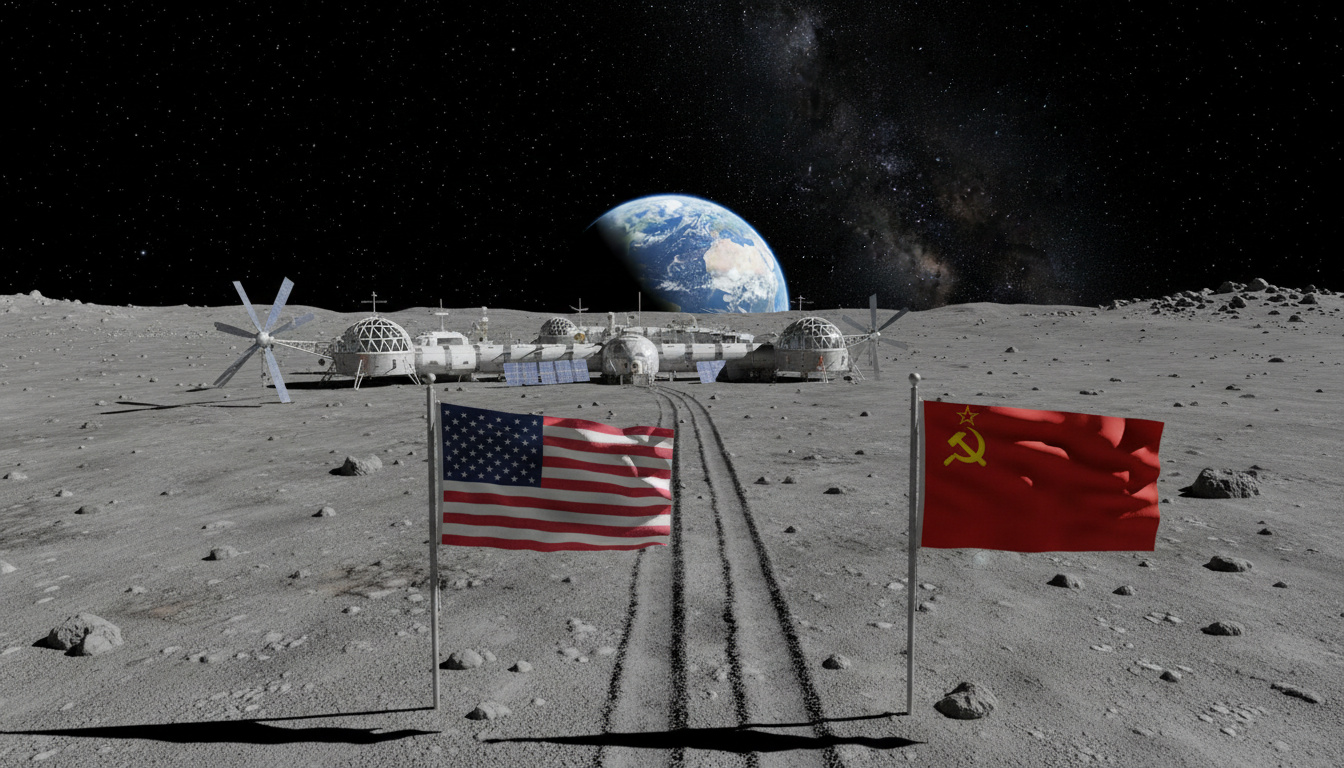

For All Mankind reimagines the space race with a single devastating twist: the Soviet Union lands on the Moon first in 1969. This Apple TV+ drama from Ronald D. Moore, Matt Wolpert, and Ben Nedivi extends the Cold War rivalry into an alternate timeline where NASA’s ambition never dims and the final frontier becomes a battleground for competing superpowers.
The series spans decades, tracing the evolution of space exploration from the crushing defeat of 1969 through lunar colonization and Martian settlement. It examines how sustained competition drives technological leaps while extracting heavy personal costs from astronauts, engineers, and their families.
Blending historical figures with fictional characters, the show explores themes of sacrifice, diversity, and corporate ambition against a backdrop of nuclear tensions and endless rivalry.
What Is For All Mankind About?
Apple TV+
4 released (Season 5 renewed)
Sci-Fi Drama / Alternate History
Joel Kinnaman as Ed Baldwin
The series operates on a divergence point in January 1966, when Soviet rocket engineer Sergei Korolev survives surgery—a procedure that killed him in reality. This survival enables the USSR to perfect their N-1 rocket and claim the lunar surface first, forcing the United States to escalate its space program indefinitely.
- Alternate history premise where the USSR achieves the first Moon landing in June 1969
- Created by Ronald D. Moore, known for Battlestar Galactica and Outlander
- Timeline spans from 1969 through the 2000s, employing decade-long jumps between seasons
- Explores accelerated technological progress through sustained Cold War competition
- Addresses diversity in the astronaut program decades ahead of real-world integration
- Incorporates private aerospace firms like Helios Aerospace in later narrative arcs
- Maintains TV-MA rating for mature themes including political intrigue and space-related casualties
| Fact | Details |
|---|---|
| Creator | Ronald D. Moore, Matt Wolpert, Ben Nedivi |
| Premiere Date | November 1, 2019 |
| Network | Apple TV+ |
| Total Episodes | 40+ |
| Historical Divergence | January 1966 (Korolev survives surgery) |
| Primary Setting | NASA, Jamestown lunar base, Happy Valley Mars colony |
| Content Rating | TV-MA |
| Rotten Tomatoes | Certified Fresh (high critical scores) |
How Many Seasons of For All Mankind Are There?
Season 1: The Red Moon (1969-1974)
The inaugural season opens with the Soviet landing and follows NASA’s frantic efforts to catch up. Astronaut Ed Baldwin emerges as a central figure while the agency establishes the Jamestown lunar base. Personal tragedies, including the hit-and-run accident involving Ed’s son Shane, intersect with professional crises like faulty hardware fatalities and FBI security probes.
Season 2: Lunar Cold War (1983)
A decade jump places the narrative in 1983, with Ellen Wilson leading NASA amid escalating lunar tensions. The season introduces Marines to the Moon, nuclear brinkmanship, and secret diplomatic trades. The finale teases the coming Mars race with a glimpse of 1995.
Season 3: The Mars Race (1992-2000s)
The third installment depicts a three-way competition between NASA, the Soviet space program, and private firm Helios Aerospace to reach Mars. Ellen Wilson’s presidential campaign runs parallel to the orbital mechanics of the Goldilocks asteroid heist. The season concludes with the establishment of the Happy Valley colony.
Season 4: Asteroid Mining (2003)
Set in 2003, this season examines the stresses of maintaining a permanent Martian settlement. The colony faces reactor meltdowns, worker riots, and terrorist bombings that claim the lives of Karen Baldwin and Molly Cobb. Cryoplant explosions and resource shortages threaten international partnerships even as the Goldilocks asteroid arrives in orbit.
Each season functions as a distinct decade-spanning chapter. While individual episodes contain self-contained crises, character relationships and political developments build cumulatively across seasons, making sequential viewing essential for understanding the full scope of the alternate history.
Season 5 Status
Apple renewed the series for a fifth season in 2024, though no confirmed release date has been announced. The narrative is expected to continue exploring the Martian colony’s expansion and the geopolitical ramifications of asteroid resource extraction.
Where Can I Watch For All Mankind?
The series streams exclusively on Apple TV+. Subscribers can access all four released seasons through the platform’s standard subscription model. The service offers 4K HDR streaming quality, which showcases the series’ extensive visual effects and period production design.
Viewers seeking similar content can explore other exclusive Apple TV+ productions that blend speculative fiction with historical elements.
Who Stars in For All Mankind?
Joel Kinnaman anchors the series as Ed Baldwin, a naval aviator turned astronaut who appears across all four seasons and multiple decades of the timeline. Jodi Balfour portrays Ellen Wilson, who evolves from astronaut to NASA administrator to political officeholder. Edi Gathegi appears as Dev Ayesa, the charismatic co-founder of Helios Aerospace.
The ensemble includes Gordo and Tracy Stevens, Molly Cobb, and Danielle Poole, representing the astronaut corps across generations. Family members and ground crew, including mission control personnel and political figures, round out the extensive cast.
Several actors portray their characters across 30+ years of narrative time using prosthetics and makeup aging techniques. This approach maintains continuity while illustrating the physical toll of space radiation and the passage of decades.
How Does the Alternate History Timeline Progress?
- January 1966: Soviet engineer Sergei Korolev survives surgery, enabling the N-1 rocket program to continue.
- June 1969: USSR lands on the Moon first, claiming the “Red Moon.”
- October 1969: NASA follows with Apollo 11, initiating an extended race rather than a concluded victory.
- 1970s: Establishment of the Jamestown lunar base and permanent lunar mining operations.
- 1983: Military presence escalates on the Moon with Marine deployments and nuclear weapon standoffs.
- 1995: First human landing on Mars occurs, decades ahead of real-world projections.
- Early 2000s: Private asteroid mining operations commence, redirecting celestial bodies for resource extraction.
- 2003: The Happy Valley Mars colony faces critical infrastructure failures and civil unrest.
What Is Confirmed and What Remains Uncertain?
| Confirmed Information | Uncertain Details |
|---|---|
| Season 5 renewed by Apple (2024) | Exact premiere date or episode count |
| Four complete seasons available (2019-2023) | Whether the series will conclude with Season 5 |
| Exclusive Apple TV+ distribution | Specific plot developments for upcoming episodes |
| Created by Ronald D. Moore and team | Potential spin-off series or companion projects |
| Not based on true events post-1969 | Final fate of key characters like Ed Baldwin |
How Does the Series Compare to Real Space History?
For All Mankind is not based on a true story, though it grounds its alternate timeline in plausible extensions of actual NASA and Soviet programs. The divergence point—Korolev’s survival—represents a single changed variable that cascades into sustained competition. Where reality saw the Apollo program conclude in 1972 and the Space Shuttle era begin in 1981, the series posits continuous lunar development leading to Mars colonies by the mid-1990s.
The show incorporates real technological concepts, including nuclear thermal propulsion and in-situ resource utilization, but accelerates their development by decades. Historical figures appear alongside fictional characters, though their biographies often diverge to accommodate the altered timeline. Viewers interested in similar speculative narratives can explore other alternate history television series that examine historical turning points.
What Do Critics Say About For All Mankind?
Critical reception has remained strongly positive across all four seasons. Rotten Tomatoes lists the series as Certified Fresh, with reviewers praising its blend of interpersonal drama and speculative space exploration.
Highly acclaimed for thrilling alternate history, character depth, and visuals.
— Rotten Tomatoes consensus
Critics have specifically highlighted the show’s handling of political intrigue and the physical risks of space travel. Loud and Clear Reviews noted the series’ success in balancing large-scale historical changes with intimate family dramas.
What Comes Next for the Series?
Season 5 will likely expand the Martian narrative while potentially introducing new locations or time periods. The unresolved tensions surrounding asteroid mining and international corporate rivalry suggest continued conflict between national space agencies and private interests. For viewers catching up, the complete series remains available on Apple TV+, with the platform holding exclusive rights to future installments.
Is For All Mankind based on a true story?
No. While it uses historical figures and real NASA programs, the series is fictional. The divergence occurs in 1966 when Soviet engineer Korolev survives surgery, enabling the USSR to reach the Moon first.
Why is it called For All Mankind?
The title references the Apollo 11 plaque and Neil Armstrong’s words, ironically highlighting how the space race in this timeline becomes less about peaceful exploration and more about national and corporate competition.
Is For All Mankind cancelled?
No. Apple renewed the series for Season 5 in 2024. Four seasons are currently streaming, with the fifth in production though no release date is confirmed.
What happened in Season 4?
Set in 2003, the season depicts the Happy Valley Mars colony facing reactor meltdowns, terrorist bombings killing Karen Baldwin and Molly Cobb, and tensions over asteroid mining operations.
Do I need to watch all seasons in order?
Yes. The narrative employs decade-long time jumps between seasons, with character arcs and political developments building cumulatively across the timeline.
How does the timeline differ from real history?
The USSR lands on the Moon first in 1969. This sparks sustained competition leading to lunar bases in the 1970s, Mars missions by 1995, and asteroid mining by 2003—decades ahead of real-world schedules.
Related stories


Liam O'Brien covers Australian politics and public affairs for Aussie Insightly.