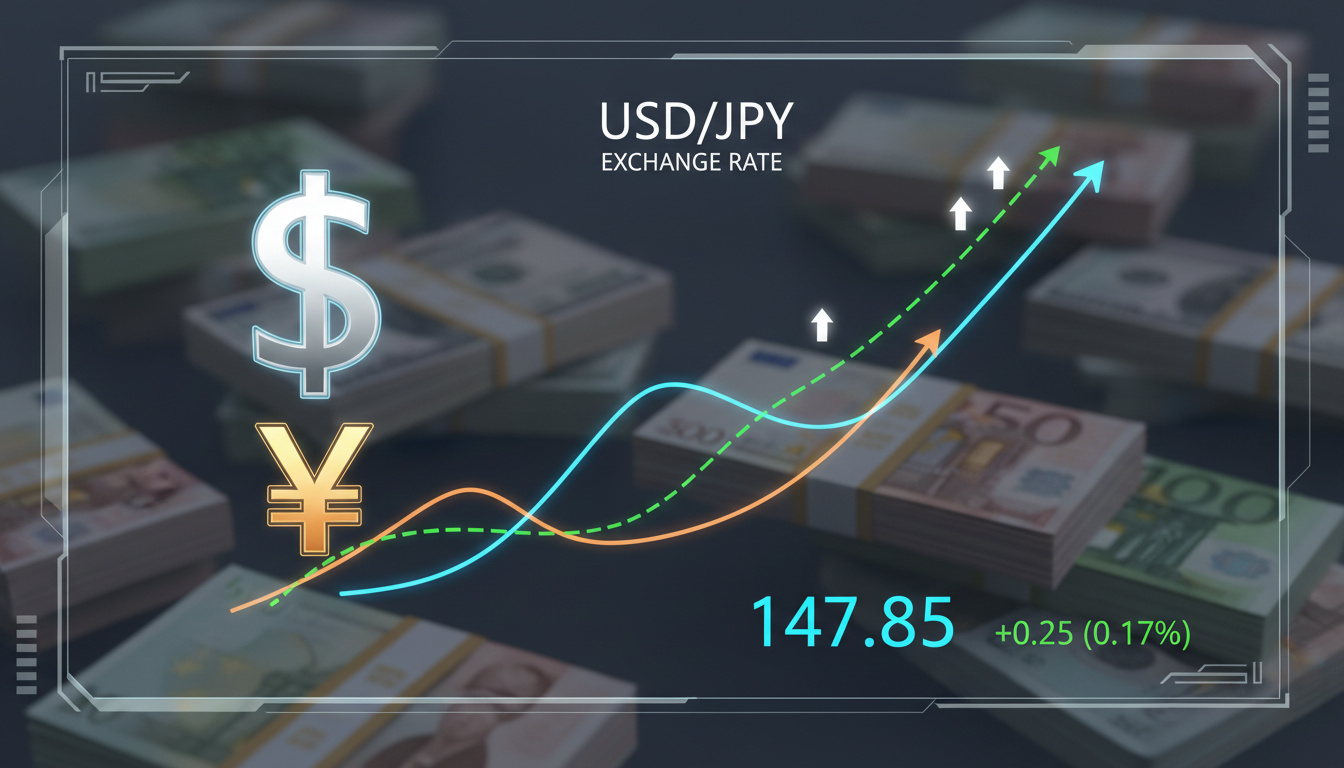

The USD/JPY exchange rate currently trades near 159.40, reflecting sustained pressure on the Japanese yen amid wide interest rate differentials between the United States and Japan. Recent data shows the pair fluctuating between 158.80 and 159.52, with the yen declining approximately 0.82% to 1.17% over the past month. This level represents a significant shift from the 151.15 average recorded in October 2025, highlighting the currency pair’s ongoing volatility.
Market participants closely monitor this pairing due to its sensitivity to central bank policy divergence and its role in global carry trade strategies. The Federal Reserve maintains benchmark rates at 3.75%, while the Bank of Japan holds rates at 0.75%, creating a yield gap that continues to drive dollar strength against the yen. Real-time trading activity peaks during Tokyo session hours as institutional investors execute currency swaps and hedging operations.
Understanding the mechanics behind these movements requires examining both immediate market data and the structural economic forces shaping long-term trends. From historical intervention points to forecast models predicting quarter-end levels near 160.21, the USD/JPY relationship offers insight into broader macroeconomic health.
What is the Current USD to Yen Exchange Rate?
Live trading data indicates USD/JPY opened near 159.397 in recent sessions, though intraday snapshots have captured rates as low as 147.166 depending on market timing and liquidity conditions. Mid-market rates for retail conversion typically hover between 158.80 and 158.82, though these figures shift continuously throughout the trading day. TradingView data confirms the pair’s sensitivity to macroeconomic announcements.
- Real-time rates fluctuate between 158.80 and 159.52 depending on session liquidity
- Federal Reserve maintains 3.75% benchmark versus Bank of Japan’s 0.75%
- Yen has depreciated 6.15% year-over-year according to macroeconomic models
- Trading volume concentrates during Tokyo business hours due to carry trade activity
- Monthly averages show appreciation from 151.15 (October 2025) to 158.69 (March 2026)
- Volatility metrics indicate 0.28% daily variance over recent seven-day periods
- Daily closes have recorded marginal declines of -0.11% to -0.58% in early April 2026
| Metric | Value | Period |
|---|---|---|
| Mid-Market Rate | 159.40 | Current |
| 24h High/Low | 159.52 / 158.81 | April 7, 2026 |
| 7-Day Volatility | 0.28% | Recent week |
| 52-Week Range | Not explicitly stated | Trailing year |
| Year Change | +2.25% | Last 12 months |
| Fed Funds Rate | 3.75% | Current policy |
| BOJ Policy Rate | 0.75% | Current policy |
| April 7 Close | 159.5160 | Daily close |
| March 31 Close | 158.8140 | Prior close |
| All-Time High | 358.44 | January 1971 |
How Has the USD/Yen Rate Changed Recently?
Short-term fluctuations in the USD/JPY pair reveal a market grappling with mixed signals from monetary authorities and shifting risk appetites. Over the past 24 hours, the pair has exhibited minimal directional conviction, registering changes between +0.01% and -0.08% across different trading platforms. XE currency data illustrates these micro-movements through live charting tools.
Daily and Weekly Volatility Patterns
Recent weekly data shows the yen trading within a 146.62 to 150.93 band, though spot rates have since pushed higher toward the 159 handle. The divergence between weekly ranges and current levels suggests either rapid appreciation of the dollar or data granularity differences between institutional spot markets and retail conversion rates. Wise historical records document these shifts through daily sampling.
Bid-ask spreads and trading volume peak during Tokyo sessions due to heightened carry trade activity, though specific numerical volume data remains undisclosed in available market feeds.
Monthly Depreciation Trends
The Japanese yen has weakened 0.82% to 1.17% over the past month according to Trading Economics, extending a longer-term downtrend that has seen the currency lose 6.15% of its value year-over-year. This gradual decline reflects persistent interest rate differentials and safe-haven flows favoring dollar-denominated assets during periods of global uncertainty.
For investors tracking cross-currency movements, the AUD to Peso – Live Rate, History & Forecast provides comparable analysis of Asia-Pacific currency dynamics.
What Factors Influence the USD to Yen Exchange Rate?
The USD/JPY exchange rate operates as a barometer for relative economic strength between the world’s largest and third-largest economies. Multiple interconnected forces drive daily pricing, from policy decisions in Washington and Tokyo to speculative positioning by global macro funds.
Interest Rate Differentials
The 300-basis-point spread between the Federal Reserve’s 3.75% benchmark and the Bank of Japan’s 0.75% policy rate creates significant arbitrage opportunities. This differential incentivizes investors to borrow yen at low costs to purchase higher-yielding dollar assets, structurally weakening the yen while boosting USD/JPY. Dukascopy market analysis charts these moves following policy announcements.
Historical charts reveal distinct pattern shifts following BOJ intervention signals in 2022 and Fed policy adjustments, with exchange rates typically moving 1-3% within 48 hours of central bank communications.
Economic Data Releases
Gross Domestic Product figures, Consumer Price Index readings, and employment reports from both nations generate immediate chart volatility. Japan’s export-oriented economy particularly influences the pair, as strong trade balances typically correlate with yen weakness due to repatriation flows and competitive devaluation strategies.
The Yen Carry Trade
Institutional investors exploit Japan’s historically low interest rates through the carry trade, borrowing yen to fund positions in higher-yielding currencies. This dynamic accelerates during Tokyo trading hours, creating sustained upward pressure on USD/JPY as dollar demand increases while yen supply expands.
Those managing currency exposure across multiple jurisdictions may find the Term Deposit Calculator – Compare Best Australian Rates 2024 useful for evaluating hedging strategies involving AUD-denominated instruments.
USD to Yen Historical Patterns and Long-Term Data
Historical analysis reveals the USD/JPY pair has traded through distinct regimes, from the fixed-rate era ending in 1971 to modern floating exchange mechanisms. The all-time high of 358.44 reached in January 1971 predates contemporary monetary frameworks, serving as a historical anchor rarely approached in recent decades.
Monthly data from late 2025 through early 2026 illustrates a steady appreciation trajectory, with averages climbing from 151.15 in October 2025 to 158.69 by March 2026. This 7.54-point move represents a 5% appreciation of the dollar against the yen over six months, significantly outpacing the long-term average of 155.44 recorded during this period. OFX historical records document these monthly closing levels.
Macroeconomic models project USD/JPY reaching 160.21 by quarter-end before retreating to 155.00 within 12 months, though geopolitical developments and unscheduled central bank interventions could invalidate these targets.
Intervention history includes the 2022 yen support operations and the 2021 USD peak, both of which appear on Investing.com historical charts as sharp inflection points. These episodes demonstrate the Bank of Japan’s willingness to enter markets during extreme volatility, though specific intervention thresholds remain undisclosed.
USD to Yen Timeline: Critical Events
- : USD/JPY reaches all-time high of 358.44 under Bretton Woods-era exchange mechanisms.
- : USD strength peaks during post-pandemic recovery, driving multi-year highs for the dollar against major currencies.
- : Bank of Japan intervenes to support weakening yen through unscheduled rate hike signals and direct market purchases.
- : Monthly average records 151.15, marking local trough before sustained dollar appreciation.
- : Temporary retracement to 155.05 average as profit-taking emerges following rapid gains.
- : Monthly average climbs to 158.69, approaching psychological 160.00 resistance zone.
- : Daily close at 159.5160 with -0.11% session decline despite broader uptrend.
Verified Data and Information Gaps
| Established Information | Uncertain or Unspecified Data |
|---|---|
| Current rates near 159.40; Fed at 3.75%, BOJ at 0.75% | Exact bid-ask spreads for institutional trades |
| Year-over-year yen depreciation of 6.15% | Precise daily trading volume figures |
| Historical high of 358.44 (January 1971) | Specific thresholds for future BOJ intervention |
| Quarter-end forecast of 160.21 per macro models | Granular timing of potential Fed policy shifts |
| Tokyo session volume peaks documented | Real-time IMF positioning data for 2024-2026 |
Why the USD/JPY Rate Matters Globally
The dollar-yen pairing functions as a primary conduit for global capital flows, influencing everything from Japanese export competitiveness to the profitability of international hedge funds. As a component of the U.S. Dollar Index and a benchmark for Asian currency stability, movements in this pair trigger ripple effects across emerging markets and developed economies alike.
Japan’s status as a major creditor nation and the yen’s traditional role as a safe-haven currency create paradoxical dynamics during risk-off events. While geopolitical uncertainty typically strengthens the yen due to repatriation flows, the current interest rate environment has seen the dollar retain bid support even during volatile periods, altering historical correlations.
Official Sources and Market Data
Market participants should note that mid-market rates serve informational purposes only; retail banks and conversion services apply additional spreads not reflected in spot pricing.
Market Data Disclaimer
Primary data sources include the TradingView USD/JPY market feeds, Bank of Japan policy announcements, and Federal Reserve Open Market Committee calendars. Treasury foreign exchange reports and IMF statistical databases provide supporting macroeconomic context, though specific 2024-2026 event details remain generalized in available research.
Key Takeaways
The USD/JPY exchange rate currently trades near multi-year highs around 159.40, driven by a 300-basis-point interest rate differential and sustained carry trade activity. While historical data from OFX and Trading Economics confirms a 5% appreciation trend since October 2025, forecast models suggest potential stabilization near 155.00 within twelve months. Investors should monitor Tokyo session liquidity patterns and official communications from the Federal Reserve and Bank of Japan for directional cues.
Frequently Asked Questions
Is the USD to Yen exchange rate fixed?
No. The USD/JPY rate operates as a free-floating currency pair determined by market forces, though the Bank of Japan occasionally intervenes during extreme volatility.
What is the mid-market rate?
The mid-market rate represents the midpoint between the buy and sell prices in the wholesale currency market, excluding retail markups or banking spreads.
How do I convert USD to Yen for international transfers?
Convert USD to JPY through licensed banks, foreign exchange brokers, or regulated fintech platforms, comparing rates against the mid-market benchmark to minimize fees.
Why does the yen weaken when Japanese interest rates remain low?
Low domestic yields encourage investors to borrow yen cheaply to invest in higher-yielding foreign assets, increasing yen supply and depressing its value relative to the dollar.
What time of day experiences the highest USD/JPY trading volume?
Trading volume peaks during Tokyo business hours due to regional market opening and carry trade execution by Japanese institutional investors.
Has the USD/JPY rate ever been higher than current levels?
Yes. The pair reached an all-time high of 358.44 in January 1971 under previous monetary regimes, though current levels represent multi-decade highs under floating-rate systems.
Do Federal Reserve decisions immediately affect the yen?
Yes. FOMC announcements typically trigger immediate USD/JPY movements as markets adjust expectations for interest rate differentials and dollar yield attractiveness.
Related stories


Liam O'Brien covers Australian politics and public affairs for Aussie Insightly.